This month, Vegas PBS proudly presents Black and Jewish America: An Interwoven History. We asked historian Claytee White to provide some context and reflect on the relationship between Black and Jewish communities across America, but also in Southern Nevada. White is the founding director of UNLV’s Oral History Research Center, and her work has chronicled the fascinating and complex history of marginalized groups in Las Vegas.
Jews made up half of the young people who participated in the Mississippi Freedom Summer in 1964.
Freedom Summer volunteers were met with violent resistance from the Ku Klux Klan and members of state and local law enforcement. News coverage of beatings, false arrests and even murder drew international attention to the civil rights movement. The increased awareness it brought to voter discrimination helped pass the Civil Rights Act of 1964 and the Voting Rights Act of 1965. Among the first wave of volunteers to arrive on June 15 were Michael Schwerner and Andrew Goodman. They along with James Chaney, a local black activist, disappeared after visiting Philadelphia, Mississippi, where they were investigating the burning of a church. Their names became nationally known as the hunt for their killers began. Six weeks later, the beaten bodies of the missing volunteers were recovered, killed by a KKK lynch mob that had the protection of local police.
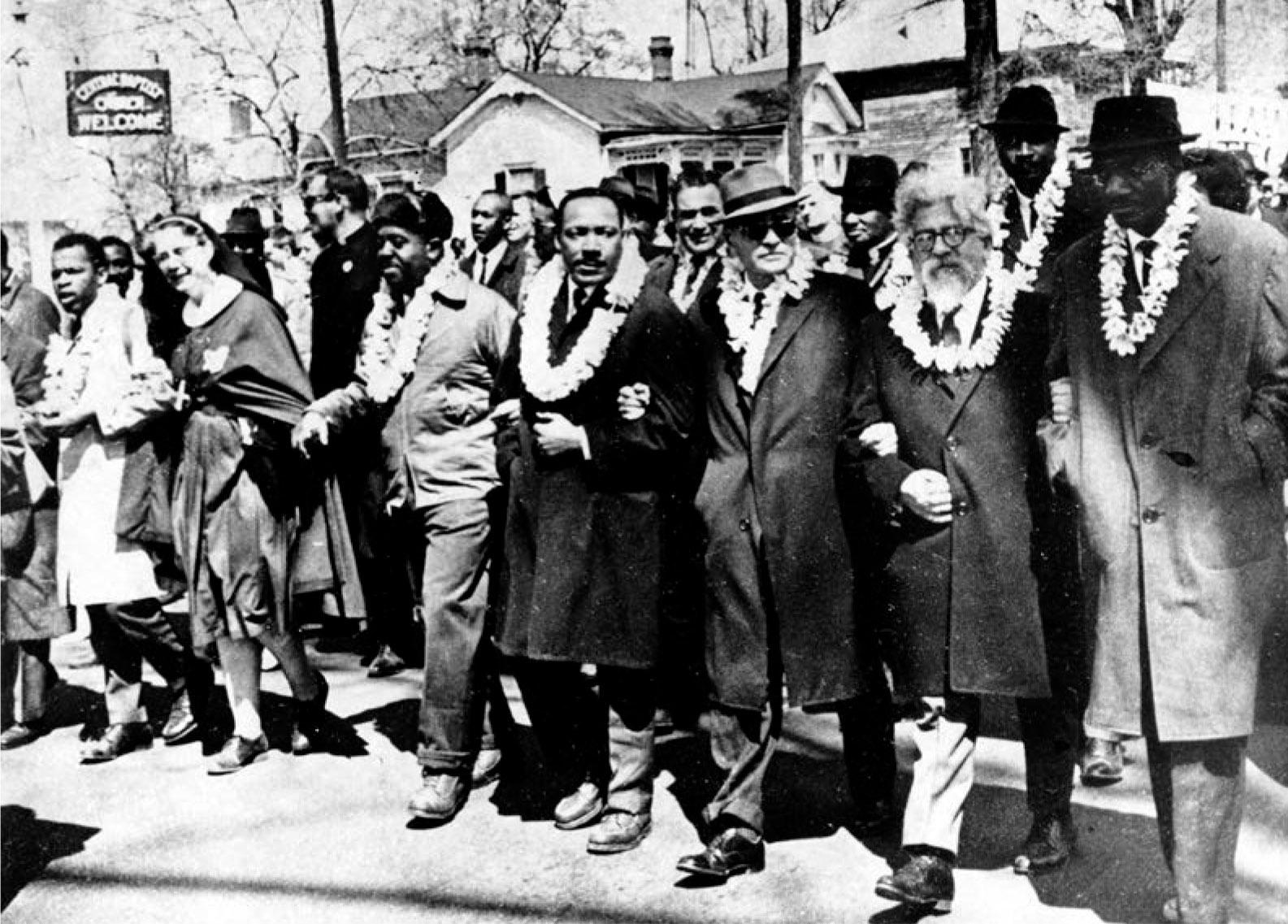
Reform Jewish leaders were arrested with Rev. Dr. Martin Luther King, Jr. in St. Augustine, Florida, in 1964 after a challenge to racial segregation in public accommodations. In 1965 Rabbi Abraham Joshua Heschel marched with Dr. King in Selma, Alabama.
Here locally, Hank Greenspun is known for his work with the NAACP and with the efforts toward integration. Later during the Welfare Rights Movement, Renee Diamond and other Jewish women were among the group who worked in many capacities with Ruby Duncan in the fight for justice for children and poverty-stricken mothers.
During the era of the 1960s, Rabbi Prinz stated, “I believe, the time has come to work together — for it is not enough to hope together, and it is not enough to pray together, but to work together for a morally renewed and united America.”
"...no group should have to fight
inequality and racism alone."
In January 2020, at the Jewish film festival when the documentary about Rabbi Prinz and Dr. Martin Luther King was shown, a woman wanted to know where Black people were now that the Jewish community was under threat. I mentioned that the threats against Black people were still looming greatly and that Black people were still mired down fighting redlining and other racist practices like unfair banking policies, the kindergarten to prison pipeline, unequal schools, undervalued neighborhoods and uneven pay.
Today, I would add to that picture of systemic racism that we are all One and no group should have to fight inequality and racism alone. It is a battle for every individual who claims to be humane, who claims to be kind, who claims to be fair-minded. They are coming for all of us… The famous poem ends, “Then they came for the Jews, and I did not speak out because I was not a Jew. Then they came for me and there was no one left to speak for me.” There is no us, them, or they. We are one. We all must stand together without pointing fingers at any one group. We are the world — Asians, Africans, South Americans, North Americans, Europeans, Australians and those in Antarctica. No one can be left out. Together, we’re saving our own lives.